
Orthopedic Injections in Kuwait: Reasons, Types, and What to Expect
Orthopedic injections sit between conservative treatment (physiotherapy, medication) and surgery. Used at the right time, in the right joint, with the right substance, they can resolve pain, restore function, and avoid an operation. Used poorly — wrong location, wrong indication, no image guidance — they are unhelpful at best and harmful at worst.
This guide explains why orthopedic injections are prescribed, the major types used in 2026, what evidence supports each one, and what to expect at the orthopedic department of ARGAN Riaya in Kuwait. Our injections are administered by orthopedic physicians and rehabilitation specialists, with on-site ultrasound and fluoroscopy guidance for accuracy.
Why your orthopedic doctor may recommend an injection
There are four legitimate reasons to perform an orthopedic injection:
1. Therapeutic — to reduce inflammation and pain
The most common reason. When a joint, bursa, or tendon is inflamed and not responding to oral medication and physiotherapy, a precisely-placed injection can deliver a high concentration of medication directly to the painful structure with minimal systemic side effects.
2. Diagnostic — to confirm the source of pain
In complex cases (for example, a patient with concurrent hip and back problems), a small injection of local anaesthetic into a specific structure can confirm whether that structure is the actual pain generator. This guides decisions about further treatment, including whether surgery would help.
3. Regenerative — to support tissue healing
Newer injections such as platelet-rich plasma (PRP) deliver concentrated growth factors to encourage repair in chronic tendon problems, mild-to-moderate osteoarthritis, and certain ligament injuries.
4. Functional — to enable rehabilitation
Sometimes pain is the barrier preventing a patient from completing rehabilitation. A well-timed injection can break the pain-disuse cycle and let the patient regain motion, strength, and confidence — at which point the underlying problem can be properly treated.
The major types of orthopedic injections
Corticosteroid (cortisone) injections
The most common orthopedic injection worldwide. A corticosteroid (typically methylprednisolone, triamcinolone, or betamethasone) is mixed with local anaesthetic and injected into a joint, bursa, tendon sheath, or epidural space. The effect typically begins within 2 to 7 days and lasts 6 to 12 weeks, sometimes longer.
Best evidence: knee osteoarthritis flares (short-term relief), shoulder bursitis and rotator cuff tendinopathy, trigger finger, carpal tunnel syndrome, plantar fasciitis (selected cases), facet joint pain, and epidural injections for radiculopathy from disc herniation.
Important cautions: the same joint should not be injected with cortisone more frequently than every 3 to 4 months, and lifetime joint injections are usually limited. Cortisone injections directly into the Achilles tendon, patellar tendon, or other weight-bearing tendons can increase rupture risk and are generally avoided.
Hyaluronic acid (HA) — viscosupplementation
HA is a natural component of joint fluid that becomes deficient in osteoarthritis. Synthetic or extracted HA is injected into the joint — usually the knee, sometimes the hip, ankle, or shoulder — to improve lubrication and reduce friction. Effect usually begins after 2 to 4 weeks and lasts 6 months or longer.
Best evidence: mild-to-moderate knee osteoarthritis in patients who have had limited relief from physiotherapy and oral medication. The international evidence base is mixed but supportive, and HA is often the next step before considering surgery.
Platelet-Rich Plasma (PRP)
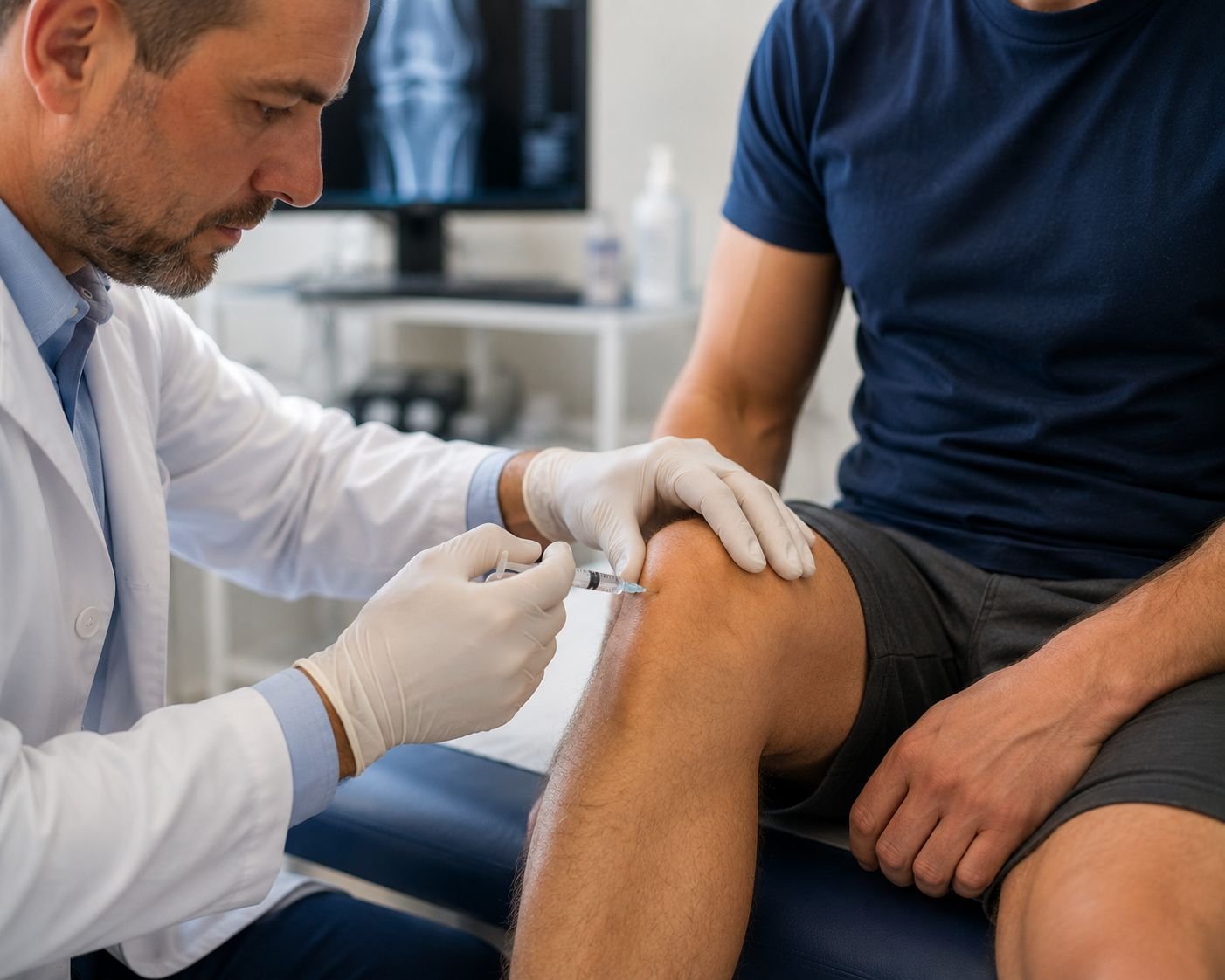
PRP is prepared from the patient’s own blood, drawn at the start of the appointment and centrifuged to concentrate the platelets and their growth factors. The concentrate is then injected into the painful structure under ultrasound guidance.
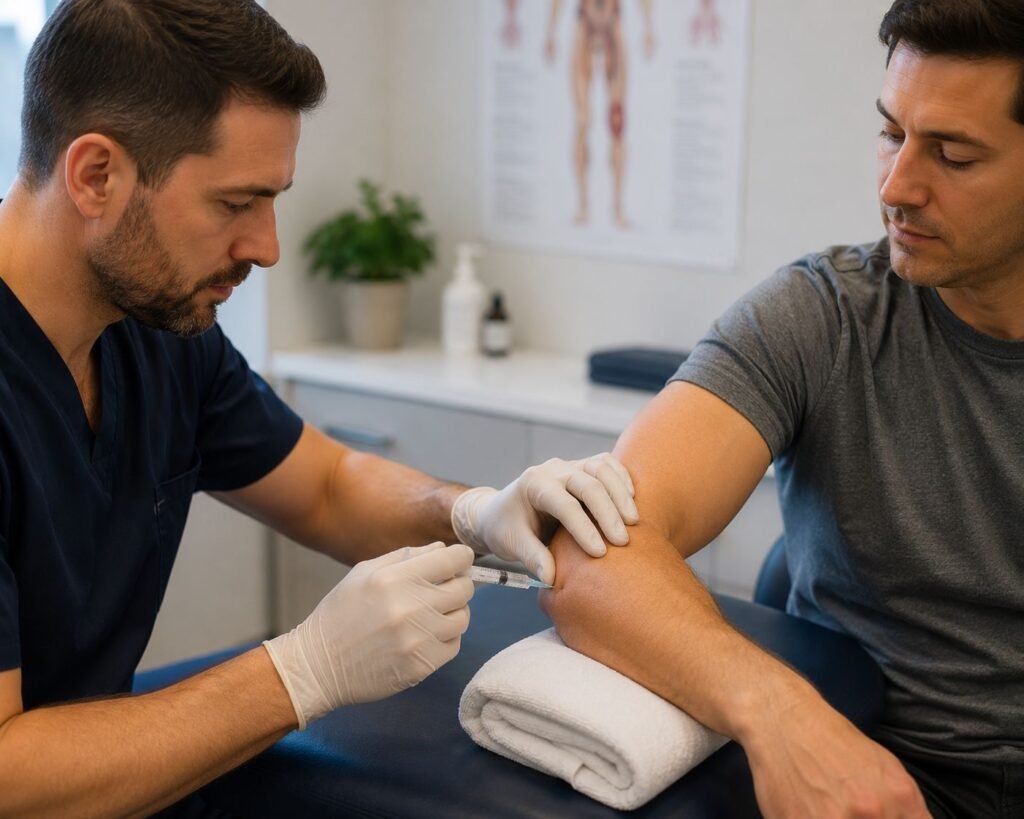
Best evidence: chronic lateral epicondylitis (tennis elbow), rotator cuff tendinopathy, plantar fasciitis, patellar tendinopathy (jumper’s knee), Achilles tendinopathy, mild-to-moderate knee osteoarthritis, and certain ligament injuries. PRP is not a cure-all — quality of preparation and accuracy of placement matter, and a course of 1 to 3 injections is typical.
Local anaesthetic (diagnostic) injections and nerve blocks
A small volume of local anaesthetic placed precisely into a structure (a facet joint, sacroiliac joint, peripheral nerve, or trigger point) confirms whether that structure is the source of pain. These are usually performed under fluoroscopy or ultrasound guidance for accuracy. Genicular nerve blocks of the knee, medial branch blocks of the spine, and suprascapular nerve blocks of the shoulder are common diagnostic-therapeutic procedures.
Trigger point injections
Tight, painful ‘knots’ in muscles (myofascial trigger points) can be injected with local anaesthetic, normal saline, or dry-needled (no fluid). Used in chronic neck and back pain, tension headache, and certain post-surgical pain syndromes.
Botulinum toxin (Botox) injections
In an orthopedic and rehabilitation context, botulinum toxin is used for: spasticity after stroke or spinal cord injury, certain forms of chronic migraine, hemifacial spasm, cervical dystonia, and selected orthopedic pain syndromes. It is not a routine treatment for joint or tendon pain.
Prolotherapy (dextrose)
A concentrated dextrose solution is injected into a ligament, tendon, or joint to provoke a controlled local healing response. Most commonly used for chronic ligament laxity and certain tendinopathies. Evidence is more limited than for PRP but the safety profile is favourable.
Why image guidance matters
Without imaging, even an experienced clinician misses the target on a meaningful percentage of small joint and tendon-sheath injections. Ultrasound guidance allows real-time visualisation of the needle, the target structure, and adjacent nerves and vessels. Fluoroscopy (live X-ray) is the standard for spine procedures (epidural, facet, sacroiliac joint injections).
ARGAN Riaya performs orthopedic injections under ultrasound guidance whenever it improves accuracy — particularly for shoulder, hip, ankle, and small-joint injections, and for all PRP and HA injections. The radiology department is in the same building, so fluoroscopy-guided spine procedures can be coordinated in the same visit.
Common conditions we treat with injections at ARGAN Riaya
- Shoulder pain — rotator cuff tendinopathy, subacromial bursitis, frozen shoulder (cortisone, PRP)
- Hip pain — greater trochanteric bursitis, hip OA
- Tennis elbow and golfer’s elbow (PRP, cortisone)
- Carpal tunnel syndrome (cortisone, hydrodissection)
- Trigger finger (cortisone)
- Plantar fasciitis (cortisone, PRP, dry needling)
- Achilles and patellar tendinopathy (PRP — cortisone avoided)
- De Quervain’s tenosynovitis (cortisone)
- Facet joint and sacroiliac joint pain (diagnostic and therapeutic)
- Lumbar radiculopathy (epidural cortisone)
- Post-stroke spasticity (botulinum toxin)
What to expect — before, during, after
Before the injection
- A focused consultation: history, examination, and review of imaging if available
- Discussion of injection options, expected benefits, alternatives (including continuing physiotherapy or doing nothing), risks, and aftercare
- Decision on image guidance, anaesthetic, and any pre-procedure instructions (some patients on blood thinners need bridging)
During the injection
- Skin is cleaned with antiseptic. Sterile technique throughout.
- Local anaesthetic is used to numb the injection site
- Ultrasound or fluoroscopy is used to guide the needle to the exact target.
- Most injections take 5 to 15 minutes once you are positioned.
After the injection
- Mild discomfort or soreness is normal for 24 to 48 hours.
- Cortisone injections sometimes cause a ‘flare’ for 1 to 2 days before improvement.
- Most patients can return to light daily activity the same day.
- Heavy physical activity is usually avoided for 24 to 72 hours.
- Physiotherapy typically resumes within a week — injections are most effective when paired with structured rehabilitation.
Risks and what they actually mean
Like any procedure, orthopedic injections carry small risks:
- Infection: rare with sterile technique (well below 1 in 10,000)
- Bleeding or bruising at the site: usually minor
- Skin or fat thinning at the injection site (cortisone): more common with repeated superficial injections
- Tendon damage: avoided by not injecting cortisone into weight-bearing tendons
- Temporary blood sugar elevation in patients with diabetes (cortisone)
- Allergic reaction to a substance used: rare
These risks are weighed against the benefit and the alternatives during your consultation. The single biggest reducer of risk is using image guidance and an experienced practitioner.
Considering an orthopedic injection in Kuwait?
ARGAN Riaya offers cortisone, hyaluronic acid, PRP, nerve blocks, and image-guided injections at our Salmiya hospital. Most injections are covered by major insurance plans operating in Kuwait. Call to book a consultation.
Frequently asked questions about orthopedic injections in Kuwait
How long do cortisone injections last?
Most patients experience relief beginning 2 to 7 days after injection, peaking at 2 to 4 weeks, and lasting 6 to 12 weeks (sometimes longer). The duration depends on the underlying condition, severity of inflammation, and how well it is paired with physiotherapy.
Are PRP injections better than cortisone?
Neither is universally ‘better’. Cortisone is faster, cheaper, and best for inflammatory flares. PRP is slower, more expensive, and better for chronic tendinopathy and certain mild-to-moderate joint conditions. For some conditions (Achilles, patellar tendon), PRP is preferred specifically because cortisone is contraindicated.
How much does an orthopedic injection cost in Kuwait?
Cortisone injections are typically the most affordable, hyaluronic acid is mid-range, and PRP is the most expensive due to the blood draw and processing equipment. Most cortisone and HA injections are covered by major insurance plans operating in Kuwait. PRP coverage varies. Call our team for a specific written quote based on your situation.
Will the injection hurt?
Most patients describe injection discomfort as moderate and brief. We numb the skin with local anaesthetic and use the smallest appropriate needle. Image guidance reduces the number of needle passes, which reduces discomfort.
How many injections can I have?
Cortisone injections in the same joint are usually limited to 3 to 4 per year and are not unlimited over a lifetime. PRP and HA do not carry the same restriction. Your physician will discuss long-term planning during your consultation.
Can I drive home after the injection?
For most peripheral injections (knee, shoulder, elbow) — yes. For epidural and facet injections under fluoroscopy with sedation, you will need someone to drive you home. We will tell you in advance.
Should I have an injection or surgery?
Most orthopedic conditions are treated stepwise: physiotherapy and lifestyle first, injections second, surgery only if those have not given enough benefit. There are exceptions (acute traumatic injuries that need immediate surgery). The decision is individual — and our orthopedic team is happy to provide a candid second opinion when surgery has been recommended elsewhere.
Will an injection cure my arthritis?
No. Injections — including PRP and HA — manage symptoms and may slow progression in some cases, but they do not reverse established osteoarthritis. They are most useful as part of a comprehensive program that also includes physiotherapy, weight management where relevant, and activity modification.