
ARGAN Riaya Specialized Hospital in Salmiya provides medically supervised aquatic physiotherapy, delivered by qualified physiotherapists inside a private specialized rehabilitation hospital in Kuwait. With eight dedicated therapy pools, we treat the conditions that are hardest to rehabilitate on land: back and joint pain, post-surgical recovery, stroke and neurological conditions, sports injuries, and childhood developmental conditions.
Warm water changes what your body can do. Buoyancy takes weight off painful joints, hydrostatic pressure helps reduce swelling, and gentle resistance rebuilds strength safely. Every programme is prescribed after a physiotherapist-led assessment, progressed as you improve, and coordinated with the rest of your care at ARGAN Riaya. Available for men and women. A doctor's referral is required; our medical department can provide one.
01
Hydrotherapy at ARGAN Riaya at a glance
Hydrotherapy at ARGAN Riaya in Salmiya, Kuwait, takes place in warm pools heated to 32-34°C, up to 140 cm deep, with a moving platform that lowers children and wheelchair users safely into the water. Sessions last 40 minutes, with separate women's and men's sections, and start with a doctor's referral.
- Water temperature
- 32-34°C
- Depth
- Up to 140 cm
- Access
- Moving platform for children and patients in wheelchairs
- Privacy
- Dedicated women's section and men's section
- Children
- No minimum age
- Session length
- 40 minutes
- How to book
- Single sessions or packages of 6, 8 or 12 sessions
- Referral
- Always needed. No referral? Book a visit with our medical department first
02
Why Choose ARGAN Riaya for Hydrotherapy in Kuwait
Aquatic therapy works when the water is the right temperature, the pool is the right depth, and a qualified therapist is in the water with you. At ARGAN Riaya, all three are standard.
- Eight dedicated therapy pools, with different depths and temperatures for different treatment goals
- Medically supervised — sessions are prescribed and delivered by qualified physiotherapists and rehabilitation specialists, not spa or beauty therapists
- Temperature-controlled warm water — held in the therapeutic range so muscles relax and pain eases from the first minutes of the session
- Underwater treadmill and aquatic gait training — low-impact walking retraining for post-surgical, neurological and orthopaedic patients
- One-to-one, therapist-led sessions — your physiotherapist is in the water with you, and you do not need to know how to swim
- Pediatric and adult programs
- Available for men and women, with a bilingual Arabic and English care team
03
What Is Hydrotherapy?
Hydrotherapy — also called aquatic therapy, aquatic physiotherapy or water physiotherapy — is physiotherapy delivered in a warm therapy pool. It uses four physical properties of water to make rehabilitation possible when land-based exercise is too painful or too difficult.
The practical result is that most patients can start moving weeks earlier in water than on land, with less pain and a far lower risk of falling. Hydrotherapy does not replace land-based physiotherapy — it is the bridge to it, and the two are usually prescribed together.
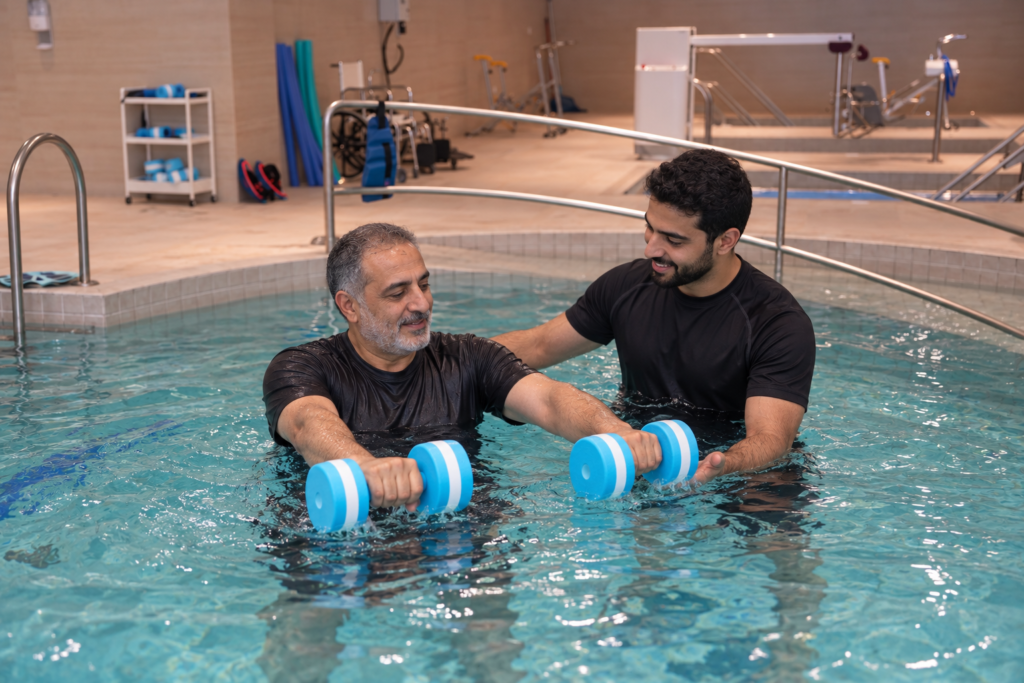
- Buoyancyoffloads body weight. Immersion to the neck removes up to about 90% of weight-bearing load, and immersion to the waist roughly half. Painful joints can move before they can bear weight.
- Warmththerapeutic water temperature relaxes muscle guarding, eases stiffness and increases tissue extensibility, so range of motion improves within the session itself.
- Hydrostatic pressureeven pressure across the immersed body supports circulation and venous return, and helps reduce swelling in a limb.
- Resistancewater resists movement in every direction, so strength and cardiovascular fitness can be rebuilt gradually with no impact on the joints.
04
Our Hydrotherapy Services
Our aquatic therapy department delivers the full clinical range, from one-to-one post-surgical rehabilitation to supervised group conditioning.
01Aquatic Physiotherapy — One-to-One Therapist-Led Sessions
The core of the programme. Your physiotherapist enters the pool with you and takes you through a prescribed exercise sequence for your diagnosis, adjusted session by session as your range, strength and confidence improve.
- An individually prescribed exercise program
- Hands-on facilitation and manual techniques performed in the water
- Progressive loading as pain settles and strength returns
- A written land-based and home exercise programme to hold the gains between sessions
- No swimming ability required — sessions are held in standing-depth water where appropriate, with flotation support
02Underwater Treadmill and Aquatic Gait Training
Walking retraining in water lets patients take full, symmetrical steps at a fraction of their body weight — long before that is safe on land.
- Gait retraining after hip, knee and ankle surgery
- Post-stroke and neurological walking rehabilitation, coordinated with our Lokomat robotic gait programme
- Return-to-running conditioning for athletes after lower-limb injury
- Endurance and cardiovascular conditioning at a controlled joint load
03Warm-Water Pool Therapy for Pain and Stiffness
For patients whose main barrier is pain rather than weakness — arthritis, chronic back pain, fibromyalgia and post-injury stiffness.
- Sustained warm-water immersion with graded mobility work
- Pain-relief and relaxation protocols before active exercise begins
- Joint mobilisation and stretching in a pain-reduced environment
- Suitable for patients who cannot yet tolerate a full land-based session
04Group Aquatic Exercise Programmes
Supervised small-group sessions for patients who have progressed beyond one-to-one care, or who do better with a structured, sociable routine.
- Arthritis and joint-health classes
- Back-care and core-stability groups
- Senior mobility, balance and fall-prevention programmes
- General conditioning for adults returning to activity
05Prenatal and Postnatal Aquatic Exercise
Low-impact conditioning and pelvic-girdle pain relief during and after pregnancy, with obstetrician clearance.
- Supervised exercise for pelvic girdle pain and pregnancy-related low back pain
- Structured postnatal return-to-exercise programs
06Combined Rehabilitation Programmes
Hydrotherapy is at its most effective as one part of a wider plan.
- Hydrotherapy + land physiotherapythe standard pairing for most orthopaedic and spinal cases
- Hydrotherapy + Lokomat robotic gait trainingfor stroke, spinal cord injury and complex neurological gait
- Hydrotherapy + manual lymphatic drainagefor post-surgical and post-oncology swelling
- Hydrotherapy + occupational therapyfor functional independence at home and at work
- Hydrotherapy + clinical nutritionfor recovery, weight management and inflammatory conditions
07Pediatric Hydrotherapy
Water is often the first place a child with a movement disorder experiences freedom of movement — and it makes therapy feel like play.
- Cerebral palsy — tone management, mobility and strength
- Developmental delay and coordination difficulties
- Rehabilitation after orthopaedic surgery in children
- Muscular dystrophy and other neuromuscular conditions
- Sensory-friendly sessions for children who respond well to water
- Parent coaching so progress continues at home

05
Who Is Hydrotherapy For?
Aquatic therapy is recommended for patients of all ages who:
- Have chronic back pain, neck pain, sciatica, or a herniated (slipped) disc
- Live with osteoarthritis, rheumatoid arthritis or persistent joint pain
- Are recovering from orthopaedic, spinal or sports surgery
- Have had a knee, hip or shoulder replacement
- Are recovering from a stroke, or living with multiple sclerosis, Parkinson's disease or spinal cord injury
- Have muscle weakness, spasticity or poor balance
- Are managing fibromyalgia or chronic widespread pain
- Have limited mobility because of injury, illness or age
- Are an athlete rehabilitating a lower-limb injury and need to keep training safely
- Are a child with cerebral palsy, developmental delay or a neuromuscular condition
- Are pregnant or postnatal and need safe, low-impact exercise (with physician clearance)
- Find land-based exercise painful because of weight or deconditioning
- Want to rebuild strength, balance and fitness without loading the joints
06
Medical and Therapeutic Benefits
01Musculoskeletal Rehabilitation and Joint Offloading
Buoyancy removes the load that makes movement painful. A patient who cannot walk the length of a corridor may walk comfortably in chest-deep water, which means strengthening and range-of-motion work can start immediately rather than after weeks of rest. In osteoarthritis, chronic back pain and post-fracture stiffness, that is often the difference between a stalled recovery and a moving one.
02Post-Surgical and Post-Injury Recovery
Hydrotherapy narrows the gap between surgery and meaningful rehabilitation. Once your wounds have healed and your surgeon has cleared you, water lets you restore movement and strength at a load your repair can tolerate. We commonly treat patients after:
- Hip, knee and shoulder replacement
- ACL, meniscus, rotator cuff and other ligament or tendon repairs
- Spinal surgery, including discectomy and fusion
- Fracture fixation and prolonged immobilisation
- Sports injuries requiring a staged return to loading
03Neurological Rehabilitation
For patients after stroke, or living with multiple sclerosis, Parkinson's disease, cerebral palsy or spinal cord injury, water provides both support and time. Balance can be challenged without the fear or the consequences of falling, and weakened muscles can produce movement that gravity would otherwise prevent. Aquatic work is coordinated with our neurological rehabilitation and Lokomat gait-training programmes so the two reinforce each other.
04Chronic Pain and Inflammatory Conditions
Warm-water immersion eases the pain and stiffness of arthritis, fibromyalgia and chronic back conditions, and it does so without medication. For many patients with chronic pain, a warm pool is the only environment in which sustained exercise is tolerable — and sustained exercise is what changes the long-term picture.
05Wellness, Conditioning and Stress Relief
Not every patient arrives with a diagnosis. Supervised warm-water exercise relieves muscle tension, supports relaxation and sleep, and builds lean strength and endurance without joint strain — a safe route back to fitness for anyone who finds gym-based or high-impact exercise painful. These sessions are still delivered by physiotherapists, and still begin with an assessment.
Your Hydrotherapy Journey at ARGAN Riaya
First Visit — Assessment
- Physiotherapist-led assessment of your history, pain, range of motion, strength and walking ability
- Review of imaging and operative reports where relevant
- Screening for the small number of situations where aquatic therapy is not appropriate — open wounds, active infection, uncontrolled cardiac conditions, incontinence
- A written plan: which pool, what water depth, session frequency, expected number of sessions, and the goals we will measure
- Clear guidance on what to bring and what to expect in the water
In the Pool — Your Session
- Sessions typically run 30 to 40 minutes, therapist-led throughout
- Pool entry by steps, ramp or hoist depending on your mobility
- Water temperature maintained in the therapeutic range
- Exercise progressed within the session according to how you respond
- Changing facilities and assistance available; a parent or carer may accompany paediatric patients
Progress Review and Discharge
- Formal re-assessment at agreed intervals against your baseline measures
- Progression from one-to-one sessions to supervised group programmes as you improve
- Transition to a land-based programme once water is no longer the limiting factor
- A written home exercise programme and long-term maintenance advice
- Coordination with your referring physician or surgeon throughout
07
Conditions We Treat with Hydrotherapy
Our aquatic therapy team in Kuwait treats the full range of musculoskeletal, neurological and developmental conditions, including:
- Chronic low back pain, neck pain and sciatica
- Herniated (slipped) disc and post-discectomy recovery
- Osteoarthritis of the knee, hip and spine
- Rheumatoid arthritis and inflammatory joint disease
- Rehabilitation after knee, hip and shoulder replacement
- Sports injuries — ACL, meniscus, ankle, hamstring, rotator cuff
- Fractures and deconditioning after prolonged immobilisation
- Scoliosis and postural conditions, alongside Schroth-method therapy
- Stroke and post-stroke hemiplegia
- Multiple sclerosis, Parkinson's disease and peripheral neuropathy
- Spinal cord injury and incomplete paralysis
- Cerebral palsy and paediatric developmental conditions
- Muscular dystrophy and neuromuscular disease
- Fibromyalgia and chronic widespread pain
- Lymphoedema and post-surgical swelling
- Obesity-related joint pain and deconditioning
- Age-related frailty, balance impairment and fall risk
- Pregnancy-related pelvic girdle and low back pain

